Topics
Our demonstrators
Using five demonstrators, we explain different approaches to reducing CO₂ – at Umwelt-Campus Birkenfeld, on site at your company or by video conference.
The demonstrators were developed with test companies from the Greater Region. They are not showpieces but tools for a conversation with your team: where does CO₂ arise in your product and production, and where is it worth starting?
1 / 5 · Making the footprint of your processes visible
Carbon footprint tool
Software that calculates the carbon footprint of processes step by step: type and amount of energy, materials, waste. Templates already exist for welding, drying and assembly.
Two variants can be compared – grid power versus green power, or two materials. The tool then shows the CO₂ difference and the cost saving. It runs as a local web application; your data stays on your computer.
One-pager (PDF, German/French) · More on this topic: Carbon footprint (LCA)
2 / 5 · Climate protection starts at the drawing board
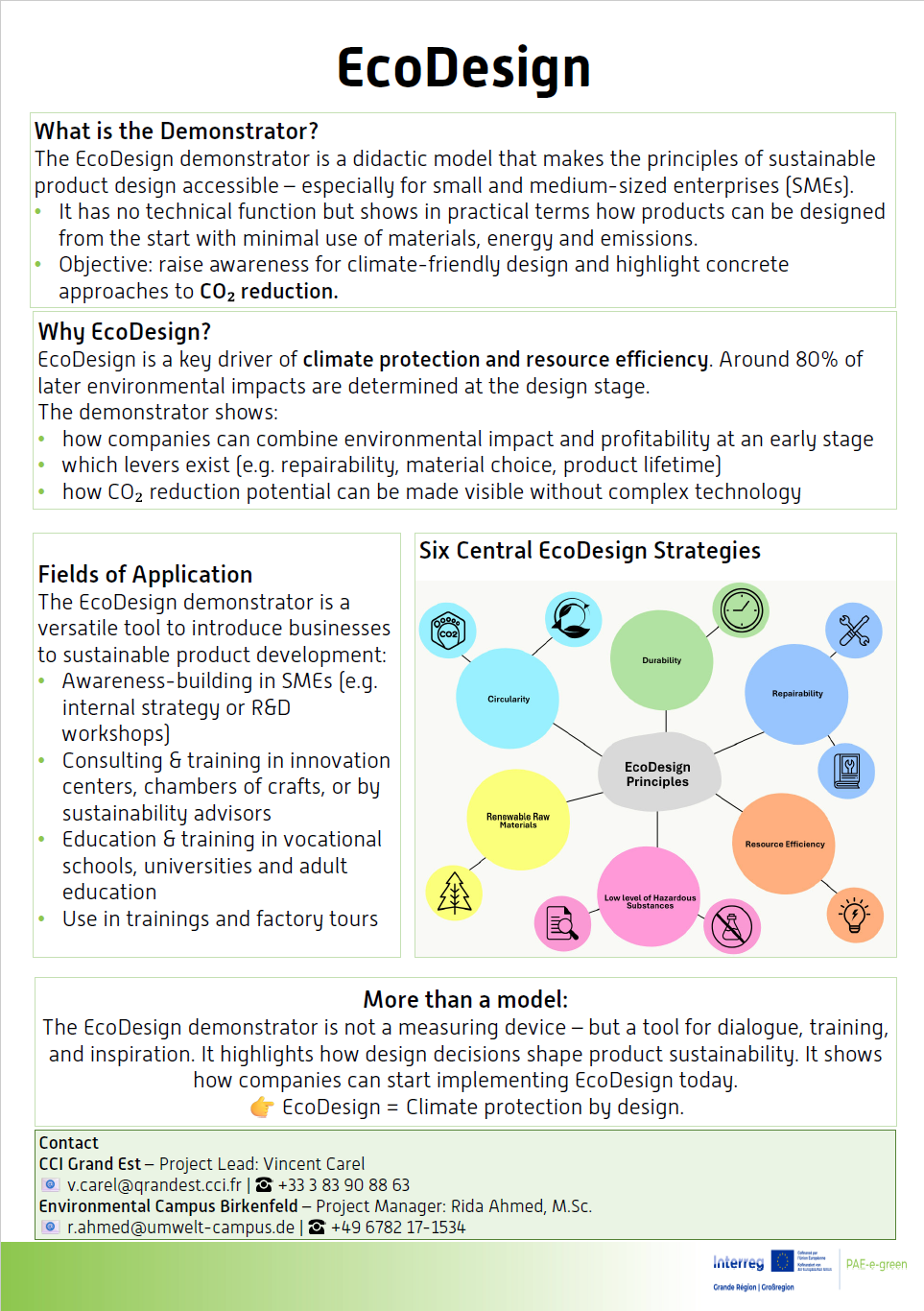
EcoDesign
Around 80 % of a product’s later environmental impact is set at the design stage. The display model shows six strategies: circularity, durability, repairability, resource efficiency, low hazardous substances and renewable materials.
A practical example: a linear guide that is screwed rather than press-fitted. Wear parts can be replaced, the product lasts longer, uses less material, emits less CO₂ – and maintenance costs fall.
One-pager (PDF, German/French) · More on this topic: Remanufacturing and business models
3 / 5 · Using power when it is green
Sector coupling
Photovoltaics, charging and production thought through together: the demonstrator captures energy and resource flows in an existing plant and matches the fluctuating availability of renewable energy to production needs.
The aims are fewer emissions, lower energy demand and lower peak loads – by shifting production capacity dynamically rather than simply switching loads off.
More on this topic: Trucks and logistics
4 / 5 · Measure first, then save
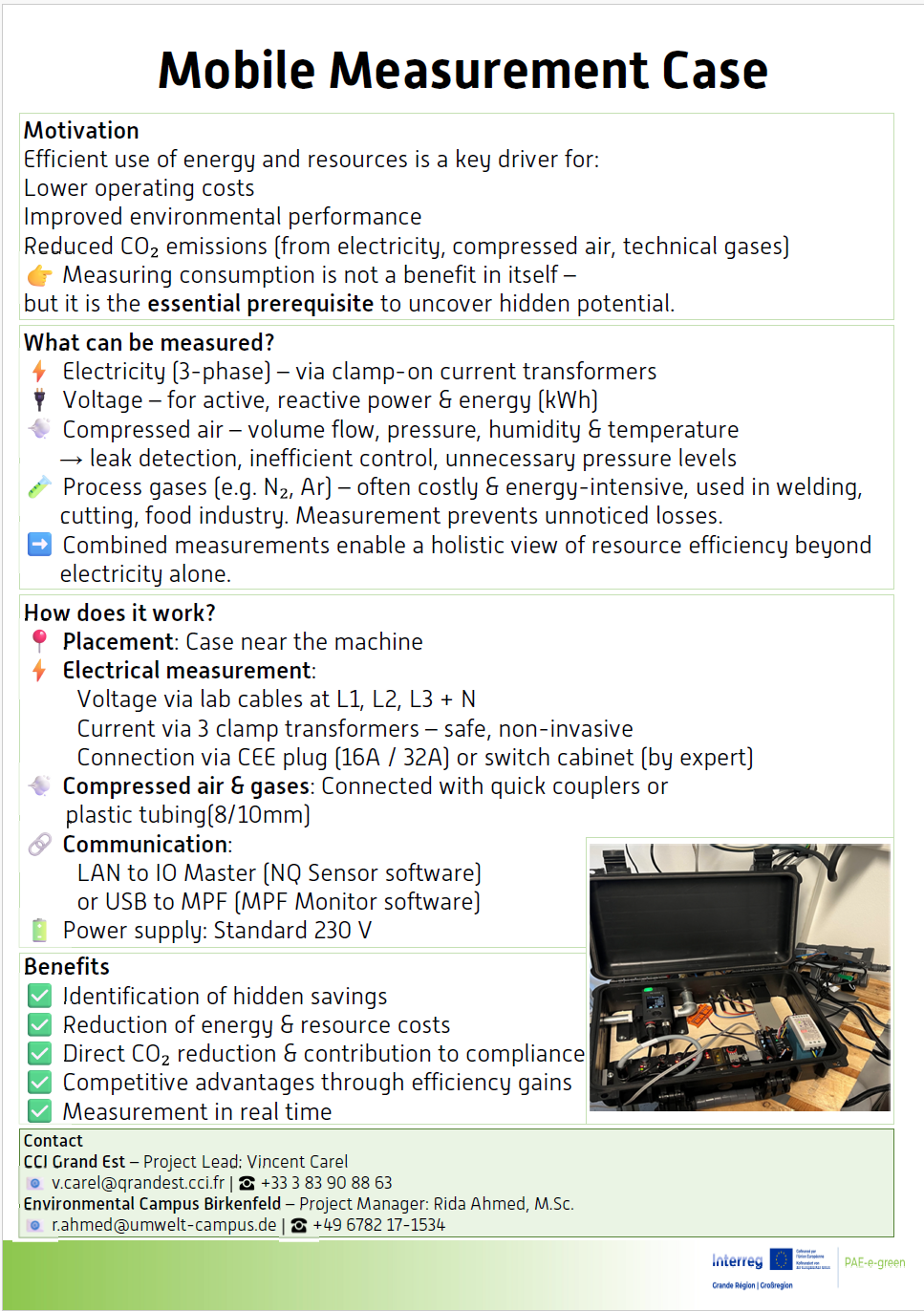
Mobile measurement case
Placed next to a machine, the case measures with industrial sensors: three-phase current via clamp-on transformers, voltage, compressed air (flow, pressure, humidity, temperature) and process gases such as nitrogen or argon.
Load profiles reveal leaks, peaks and unnecessary base loads – often after just a week of measurement. A retrofit module fills gaps in existing metering. Measuring saves nothing by itself, but it is the prerequisite for unlocking hidden potential.
5 / 5 · Production waste as a raw material
Plastics recycling
An extruder and a display model show the path of post-industrial waste: generation, collection, sorting, shredding, granulate, reuse – with real samples, recyclate next to virgin material.
Production waste is usually clean and single-type, making it a good source of high-quality recyclate. It does not fully close the loop, though – that also needs post-consumer recycling.
One-pager (PDF, German/French) · More on this topic: Remanufacturing and business models
Fact sheets
To print
Book an appointment
Are you an automotive company in the Greater Region?
Then talk to us about your topics. Book an appointment – on site at your company or by video conference.
- CO₂ measurement
- Life cycle assessment (LCA)
- Re-X strategies
- Re-X methods
- Digital product passport (DPP)
- Trucks and logistics
- Ecodesign
Re-X: reuse, repair, remanufacture, recycle. DPP: digital product passport, which brings together data on a product’s materials, origin and CO₂.
Your first consultation
- Free of charge for companies from the Greater Region
- Two hours on site at your company or online
- Or half a day at the university – with the demonstrators
Request an appointment or contact your local contact directly