About PAE-e-green
Shaping sustainable electromobility together
The future of mobility is electric – and sustainable.
The PAE-e-green project takes on the challenge of decarbonising the entire electromobility value chain in the Greater Region. Our mission: to significantly reduce the carbon footprint of the automotive industry while creating new opportunities for sustainable development.
Our aim
PAE-e-green aims to help decarbonise the electromobility value chain in the Greater Region while creating new sustainable development opportunities for its players – companies, research centres and universities – that advance the transition to a circular economy.
The Greater Region’s automotive industry has been shaped by the combustion engine. The shift to electromobility is changing its whole ecosystem and reaching more and more small and medium-sized enterprises. We see an opportunity in this: using the circular economy, efficiency and the research capacity of neighbouring regions safeguards competitiveness and jobs.
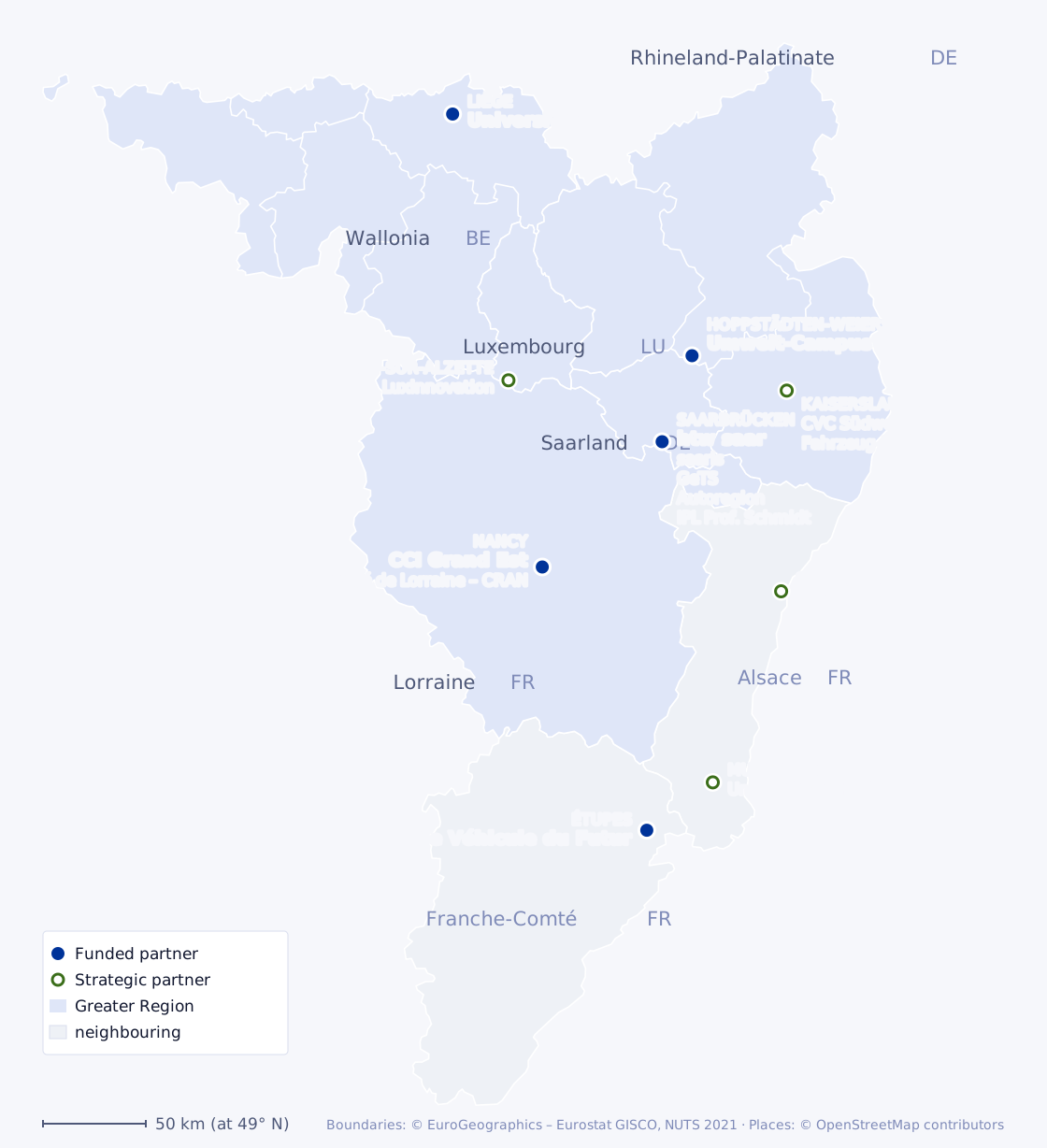
- 5funded partners in France, Germany and Belgium
- 10strategic partners, including in Luxembourg
- approx. €2.7 mtotal budget, 60 % from EU funds
- 60 months1 July 2023 to 30 June 2028
What we do
Five areas of work
Mapping the value chain
An overview of all electromobility players in the Greater Region – companies, service providers, research – across every link of the chain. Nothing like it existed before.
Assessing the carbon footprint
A tool that lets even smaller suppliers assess the carbon footprint of their products and processes simply and clearly – with a particular focus on the battery ecosystem.
Building demonstrators
Five demonstrators, developed with test companies from the sub-regions and led by Umwelt-Campus Birkenfeld: carbon footprint tool, EcoDesign, sector coupling, mobile measurement case and plastics recycling.
See the demonstrators →Optimising the life cycle
Who in the Greater Region offers recycling, ecodesign, remanufacturing and repair? Thematic webinars, a guide to sourcing lower-carbon components and manufacturers’ good practice in repair and refurbishment.
Building a network
Tech site visits in every region, B2B meetings, the PAE-e-green Days – and next, events on electric trucks and charging infrastructure along cross-border routes, plus workshops on digital product passports modelled on the battery passport.
To the events →Who it is for
Who benefits
- Small and medium-sized enterprises in the automotive sector of the Greater Region and the neighbouring Grand Est, especially members of the automotive clusters
- Universities and research institutions, whose expertise in decarbonisation, repair and refurbishment has so far rarely been used across borders
- Automotive clusters in the Greater Region
- Employees in the automotive sector
Innovation you can see
Our demonstrators
What does a climate-friendly value chain look like in practice? Our demonstrators provide the answer. They show how decarbonisation strategies can be implemented – from production and supply chains to charging infrastructure, recycling and end-of-life solutions for electric vehicles.
These demonstrators are more than models: they inspire companies and research institutions to actively shape the future.
Carbon footprint tool
Software that calculates the carbon footprint of processes step by step and compares two variants – including cost savings. Templates already exist for welding, drying and assembly.
One-pager (PDF, German/French, 0.9 MB) →EcoDesign
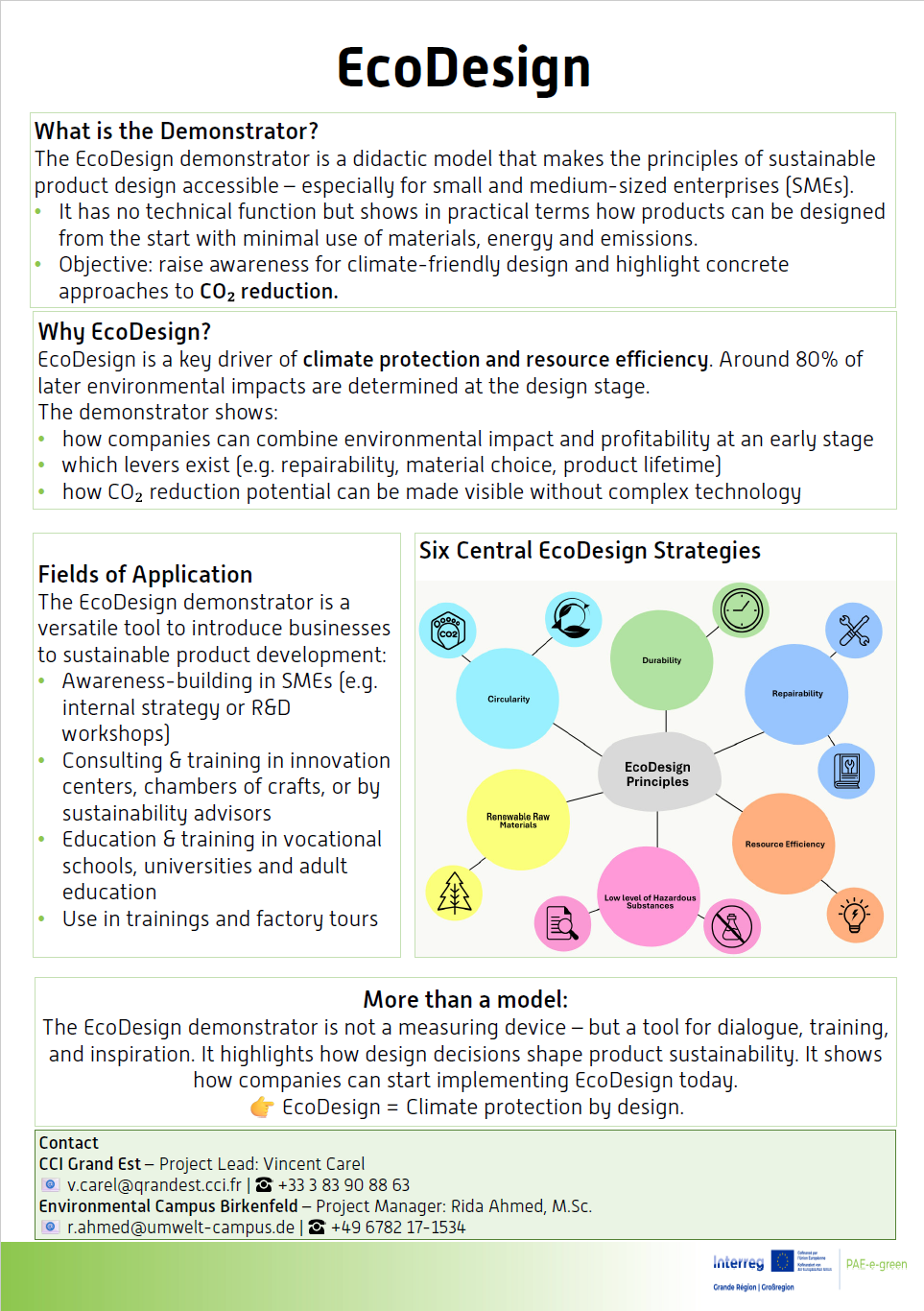
A display model for sustainable product design built around six strategies – with, as a practical example, a linear guide that is screwed rather than press-fitted and can therefore be repaired.
One-pager (PDF, German/French, 150 KB) →Sector coupling
Thinking photovoltaics, charging infrastructure and production together: capturing energy and resource flows, cutting peak loads and using fluctuating renewable power when it is available.
Mobile measurement case
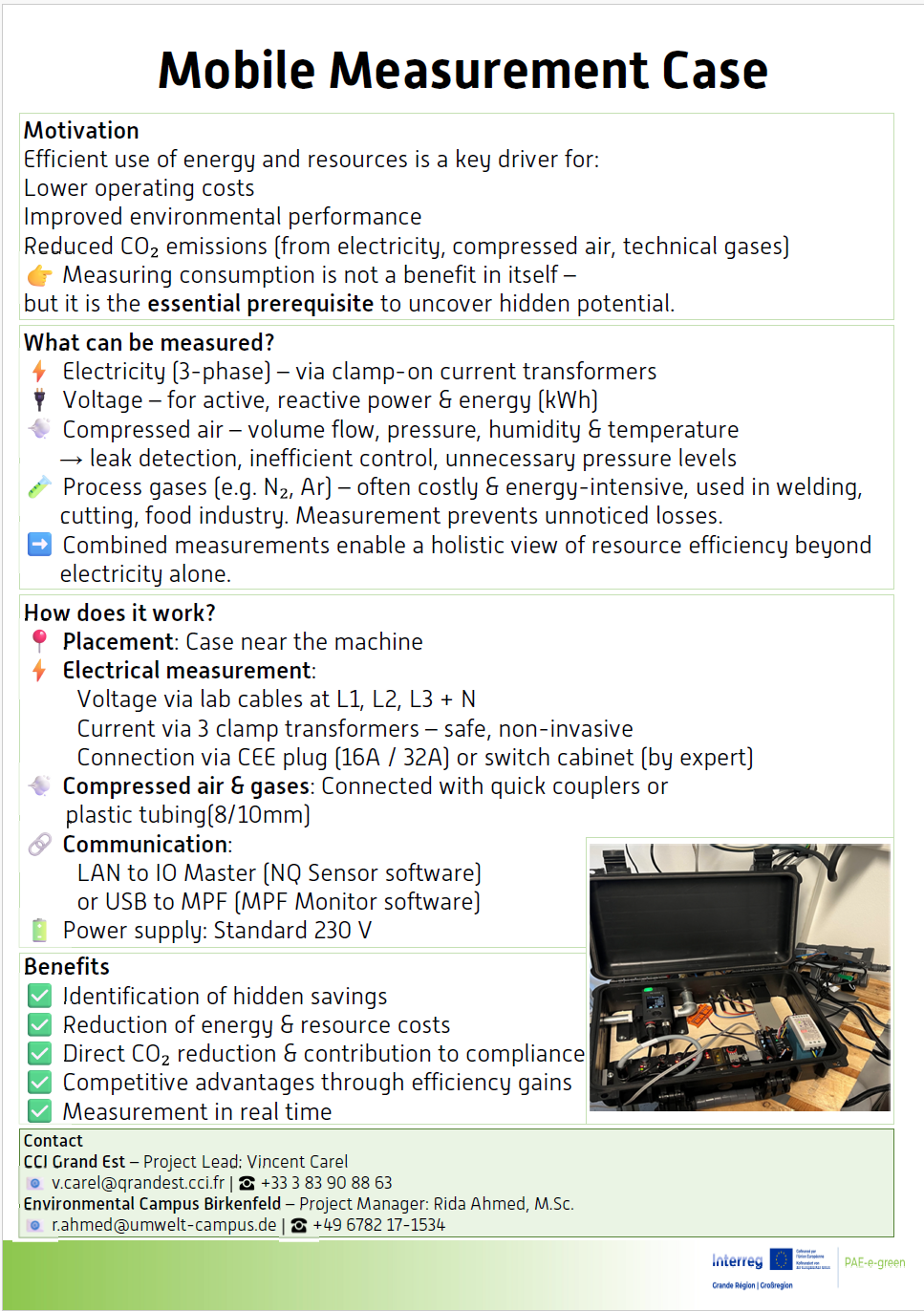
Placed next to a machine, it measures current, voltage, compressed air and process gases. Load profiles reveal leaks, peaks and unnecessary base loads.
One-pager (PDF, German/French, 390 KB) →Plastics recycling
An extruder and a display model show how production waste is collected, sorted, shredded and reused as granulate.
One-pager (PDF, German/French, 170 KB) →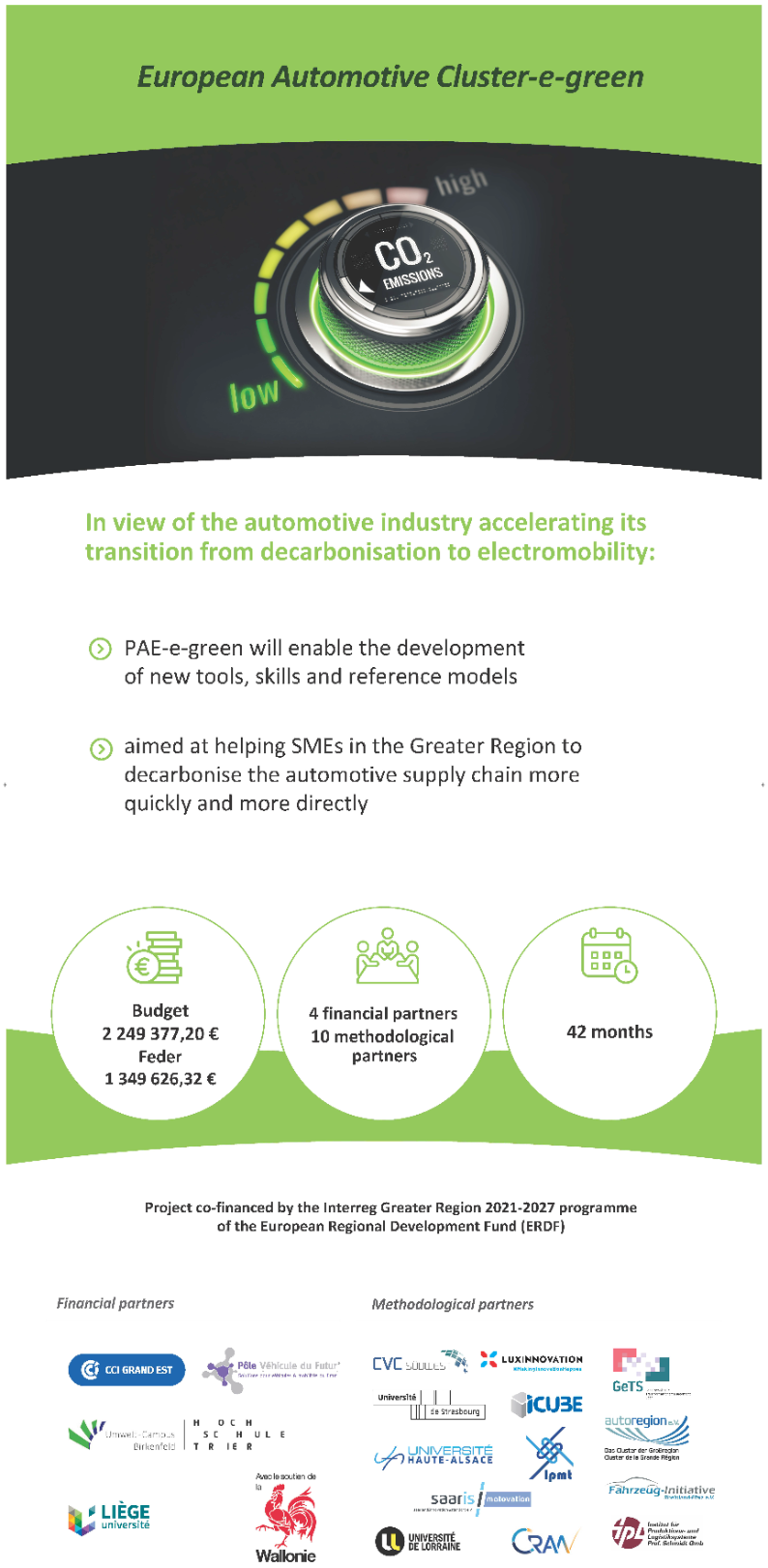
Our partners
A strong network
PAE-e-green builds on the network of the Interreg project PAE (2018–2022), whose “Tomorrow in Motion” forum drew more than 250 participants.
| Funded partner | Country | Role |
|---|---|---|
| Chambre de Commerce et d’Industrie Grand Est | FR | Lead partner and communication |
| Pôle Véhicule du Futur | FR | Automotive cluster, involving companies in France |
| Trier University of Applied Sciences – Umwelt-Campus Birkenfeld | DE | Coordination in Germany, demonstrators |
| University of Liège | BE | Life cycle: recycling, ecodesign, repair; contact in Wallonia |
| htw saar | DE | Electric trucks and charging infrastructure for cross-border transport |
Strategic partners: Commercial Vehicle Cluster (CVC Südwest), Luxinnovation, University of Strasbourg (ICube laboratory), Université de Haute-Alsace, Université de Lorraine (CRAN), saaris – Saarland Innovation & Standort, GeTS – Gesellschaft für Transformationsmanagement Saar, Autoregion e.V., Fahrzeug-Initiative Rheinland-Pfalz and the Institut für Produktions- und Logistiksysteme Prof. Schmidt.
Your local contact: in France CCI Grand Est and Pôle Véhicule du Futur; in Germany Umwelt-Campus Birkenfeld and htw saar – in Saarland together with saaris, GeTS and Autoregion, in Rhineland-Palatinate with CVC Südwest; in Luxembourg Luxinnovation; in Wallonia the University of Liège.
Book an appointment
Are you an automotive company in the Greater Region?
Then talk to us about your topics. Book an appointment – on site at your company or by video conference.
- CO₂ measurement
- Life cycle assessment (LCA)
- Re-X strategies
- Re-X methods
- Digital product passport (DPP)
- Trucks and logistics
- Ecodesign
Re-X: reuse, repair, remanufacture, recycle. DPP: digital product passport, which brings together data on a product’s materials, origin and CO₂.
Your first consultation
- Free of charge for companies from the Greater Region
- Two hours on site at your company or online
- Or half a day at the university – with the demonstrators
Request an appointment or contact your local contact directly
Funding programme
Interreg A – Greater Region
Interreg A – Greater Region (Grande Région / Großregion) is a cross-border cooperation programme of the European Union, co-funded by the European Regional Development Fund (ERDF). It aims to strengthen cooperation between the four countries of the Greater Region – Germany, France, Belgium and Luxembourg – and to promote solutions to shared challenges at regional and local level.
In the current funding period (2021–2027), almost €182 million is available for three types of projects: classic projects, small projects and functional area projects. Thematic priorities include:
- Green transition – ecological infrastructure and renewable energy
- Social cohesion and inclusion – better access to healthcare, education and labour markets
- Territorial proximity – connectivity and cultural exchange between citizens